
Audio Damage Traverse v1.0.0 VST3 AU AAX CLAP LV2
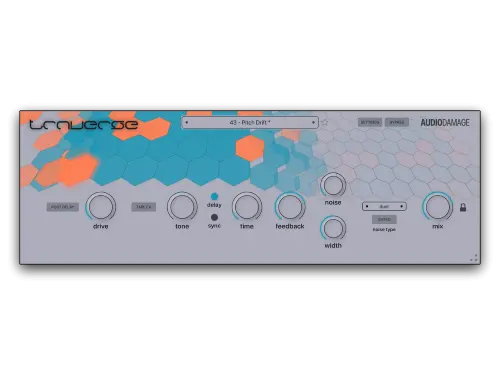
Traverse is a lo-fi tape effect and stereo delay plugin designed to combine vintage cassette character with modern spatial control in a single workflow. At its core, it merges a fully modeled tape engine with a flexible stereo delay system, allowing you to move seamlessly between degraded tape coloration and precise echo design.
The cassette section is driven by a hysteresis-modeled tape engine featuring Drive, Wow, Flutter, and a tilt-style Tone control. The delay section provides classic timing tools including Time, Feedback, Width, and sync-based divisions with optional ping-pong behavior. A Post-Delay routing switch allows you to reorder the signal path, turning Traverse into either a tape-saturated delay or a delay processed through cassette degradation.
Layered on top is a four-control splice system that introduces procedural tape dropouts, along with a built-in noise generator offering nine distinct noise types: Hiss, Crackle, Dust, Fan Rumble, 60Hz Hum, 50Hz Hum, White, Pink, and Califone Card Reader. The noise is routed directly into the cassette engine, meaning it evolves dynamically as it passes through the same coloration and feedback stages as your audio.
Traverse is the third release in our Motion Effects series, alongside Ascent and Descent. It is available across Mac, Windows, Linux, and iOS, and comes with a perpetual license—no DRM, no subscriptions, and no hardware dongles.
Creative Applications
Traverse is designed for both subtle enhancement and extreme sound design. Drum buses can be aged into saturated, tape-worn textures with minimal Drive and moderate Wow settings. Vocals respond well to added noise and modulation, creating lo-fi radio-style presence or degraded broadcast character.
Pads and atmospheric layers benefit from higher splice activity and noise interaction, producing evolving, unstable textures ideal for ambient or experimental production. On guitar or sustained harmonic material, increasing Feedback transforms the delay into self-saturating drones with organic motion and harmonic bloom.
Features
Cassette Engine
A detailed tape-emulation system based on magnetic hysteresis modeling, combining pre-emphasis and de-emphasis filtering with oversampled saturation stages. The result is a dynamic, history-dependent response that behaves like real tape rather than static distortion, with consistent output level across the full Drive range.
Drive
Transitions from clean tape coloration to heavy saturation and oxide-style degradation. The response curve adapts to signal history, producing nonlinear behavior that evolves over time.
Wow & Flutter
Independent modulation controls for slow pitch drift (Wow) and fast jitter (Flutter), each driven by dedicated LFO systems with added noise variation. Stereo-phase offset creates natural tape instability and widening movement.
Tone
A bipolar tilt EQ integrated into the tape path, shifting the signal from dark and weighty to bright and present within a single control.
Tape-in-Loop Feedback
All delay repeats are continuously reprocessed through the cassette engine, allowing echoes to degrade, saturate, and evolve into dense, textured soundscapes when Feedback is increased.
Time
Stereo delay ranging from 20 ms to 10 seconds, with optional tempo synchronization supporting straight and triplet divisions from 1/32 notes up to whole notes.
Feedback
Controlled regeneration with built-in limiting to prevent runaway oscillation, even under extreme Drive settings.
Width
Continuous stereo spread control with optional ping-pong routing and cross-channel feedback behavior.
Splice System
A procedural tape dropout engine with four interactive parameters: event rate, depth, pitch modulation, and amplitude instability. Capable of everything from subtle tape wear to erratic, broken-machine artifacts.
Noise Generator
Nine curated noise profiles including analog hums, tape hiss, vinyl-like crackle, and mechanical textures. Noise is processed through the cassette engine for fully integrated degradation behavior.
Gated Noise
Automatically reduces noise floor during silence, preserving musical clarity between phrases while retaining character during playback.
Routing Control
A Post-Delay toggle switches processing order between cassette-first or delay-first architectures, enabling both classic tape echo and modern hybrid configurations.
Mix
Standard wet/dry blend with a default fully-wet configuration for immediate effect-based use.
Bypass
Click-free 50 ms crossfade bypass for smooth transitions in both studio and live performance contexts.



![Apisonic Audio Speedrum 2 v2.4.0 VST2 VST3 AAX [WIN]](https://freshstuff4you.com/wp-content/uploads/2026/10/speedrum-2-90x90.webp)

